An Omani sign-language avatar that any website or app can add in minutes.
Text on a page becomes real-time signing by a 3D Omani avatar. Deaf reviewers approve every sign, a studio lets the sign team grow the library every week, and systems connect with one script tag — no video files and no changes to the host system.
For many deaf citizens, sign language is the first language — not written Arabic.
Service and education portals were readable only as text, and every organisation that wanted signing would have had to film videos page by page. We built one shared sign-language hub instead: an avatar that signs any text, a dictionary governed by deaf reviewers, and a connector that brings both to any website or app.
02 · How it works
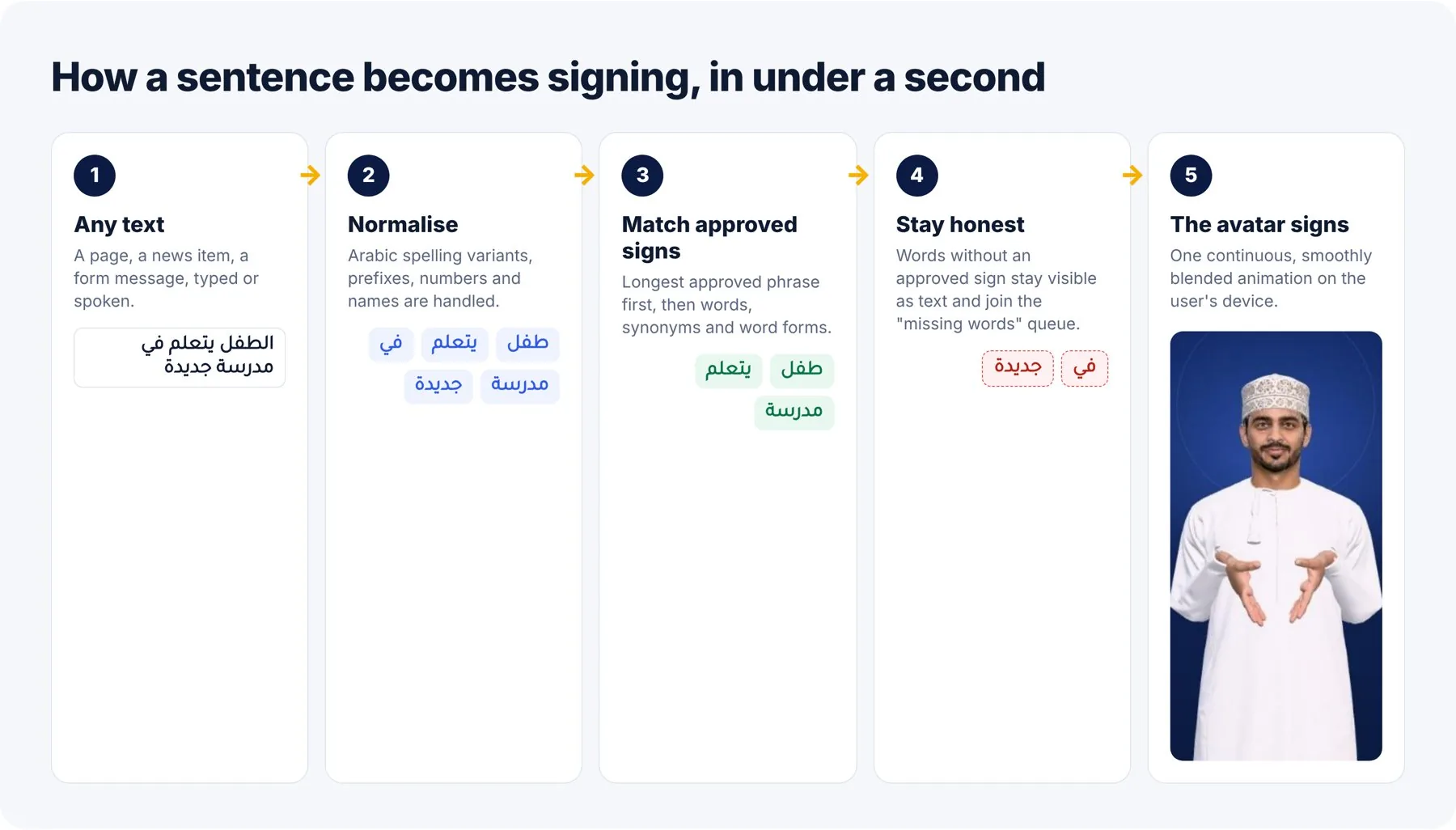
A sentence becomes signing in under a second
Arabic spelling variants, prefixes and numbers are normalised; the longest approved phrase is matched first; words with no approved sign stay visible as text and join a “missing words” queue. Nothing is guessed.
03 · Many languages, one sign
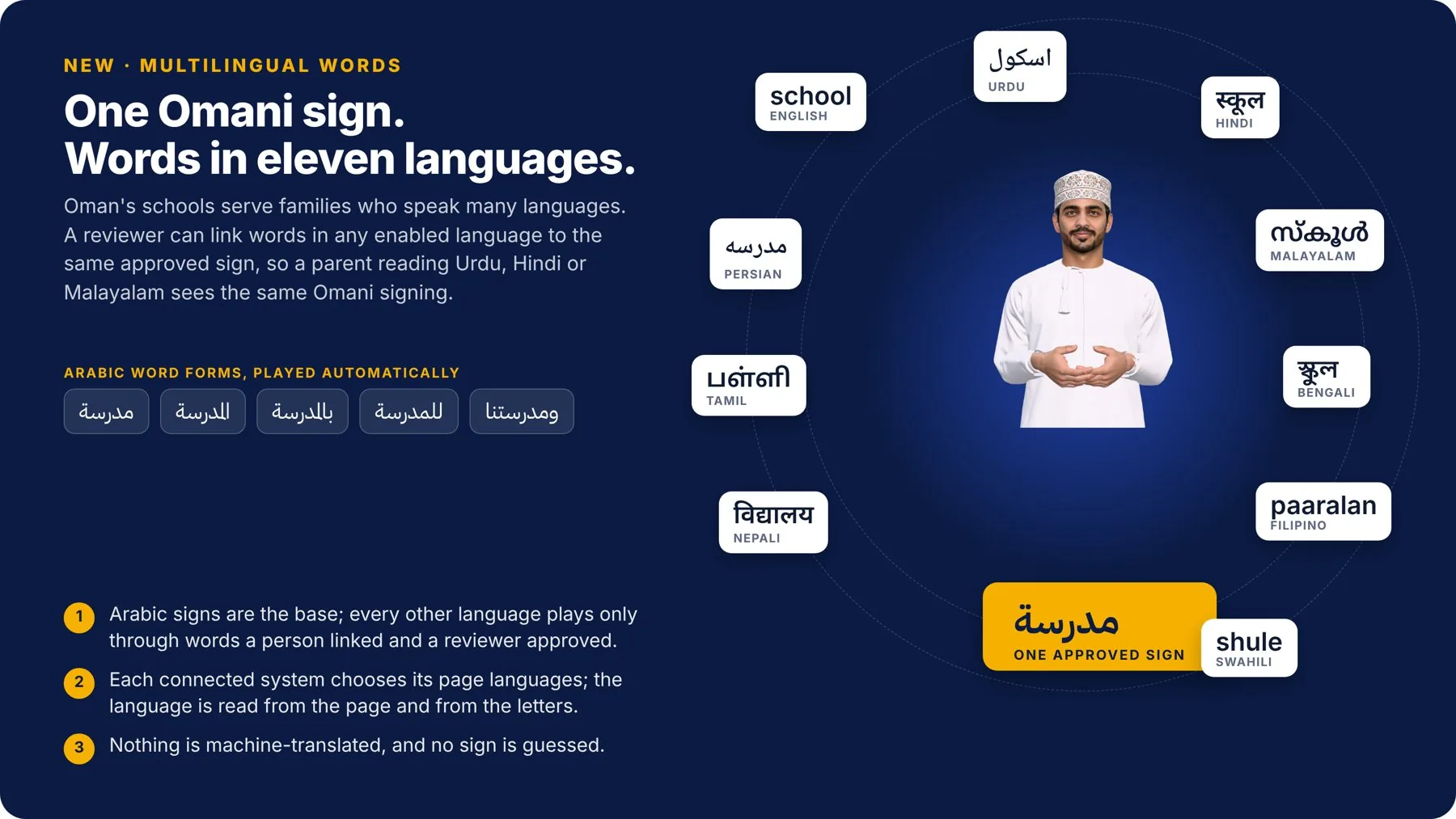
One Omani sign. Words in eleven languages.
Families read in Urdu, Hindi, Malayalam, Tamil and more. A reviewer links words in any enabled language to the same approved sign, so every parent sees the same Omani signing. Nothing is machine-translated.
04 · For the sign team
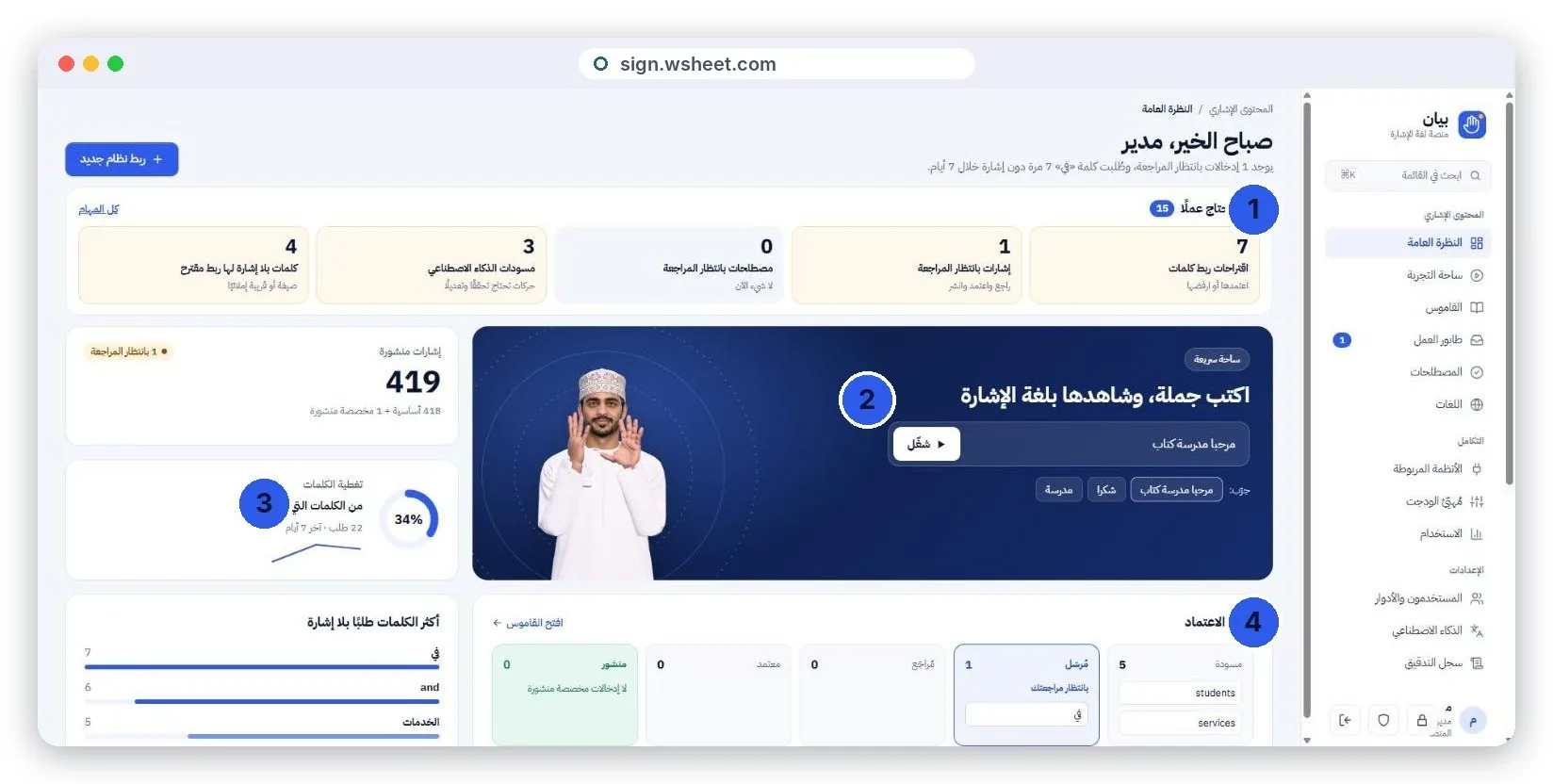
A console where the library grows every week
Type a sentence and watch it signed. See which words people needed that have no sign yet, review AI-drafted motions, and move each sign through draft → review → approval → publish, with a full audit trail.
05 · Motion studio
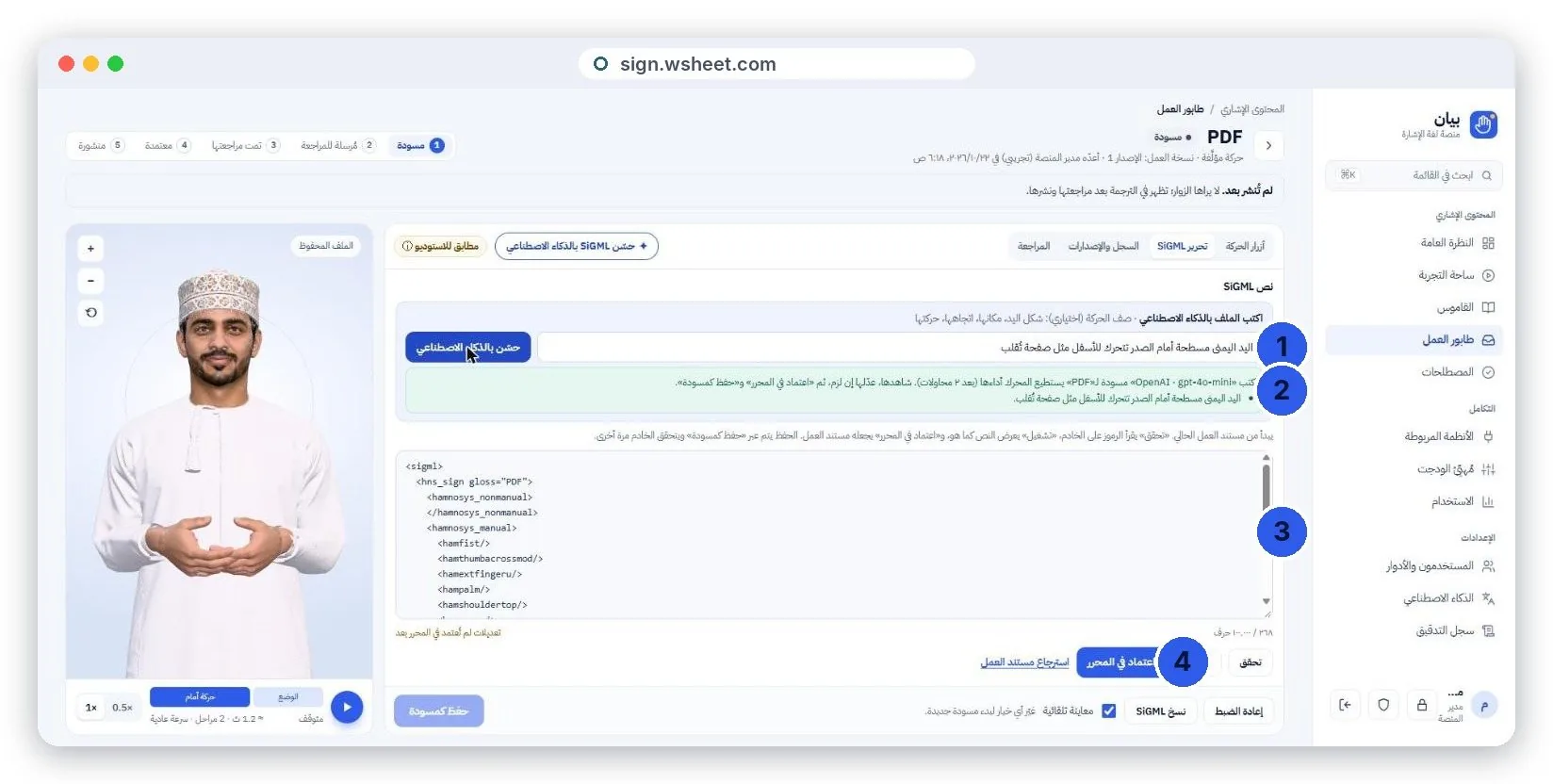
Our own motion engine — no video, about 1 KB per sign
Signs are stored as compact notation, not video, and our engine turns them into smooth avatar movement on the user’s device. Editors adjust hand shapes, positions and timing in the studio and preview instantly.
06 · Any system, four steps
Connected in under 15 minutes
No change to the host system’s back end, no data migration and no new servers on the client side.
1Register the systemEnter its name and allowed domains; receive a public key.
2Choose tools & languagesPick the toolbar tools and page languages to enable.
3Paste one script tagWorks with any CMS or framework, plus native mobile SDKs.
4Go live, follow usageSee coverage, requests and missing words in the console.
The deaf user signs back — the staff member reads it
In a live service conversation the camera reads hand and body points on the user’s own device, and a recognition model trained on Omani signing turns them into a clear sentence. Video never leaves the device.
Fingerspelling and approved signs
Learns from consented, reviewed recordings
Honest results: low confidence asks again
08 · AI, with limits
Five helpers for the sign team. Zero AI in the public path.
AI agents run inside your organisation by default to protect your data; an external provider is used only if you enable it. Every suggestion is a draft that a person approves.
Plain Arabic rewriteSimplifies complex text before it is signed — as a draft.
Link suggestionsProposes which approved sign a missing word should use.
Words for a signSuggests words in other languages for an existing sign.
Draft a new signWrites a first notation draft for the studio to refine.
Daily helperSummarises the most-requested missing words.
Never done by AIApproving, publishing or changing a live sign — enforced by the server.
09 · Built in
Accessibility toolkit, security and ownership
14 accessibility toolsContrast, text size, dyslexia-friendly font, reading guide, read-aloud and more.
4 mobile SDKsAndroid, iOS, Flutter and React Native share the same avatar and library.
People approve every signNothing reaches the public library without a human reviewer.
Your data stays with youHosted inside your organisation, with identity, audit and backups built in.
Questions people ask
Can Bayan be added to an existing website?
Yes. A site adds one script tag and a public key; the avatar runs in an isolated frame, so the host site’s code does not change.
Does it work in mobile apps?
Yes. The same hub serves native SDKs for Android, iOS, Flutter and React Native.
Does it need video files?
No. Signs are stored as compact notation — about 1 KB each — and animated on the user’s device.
Who approves the signs?
Deaf reviewers. AI can draft and suggest, but approving or publishing a sign is always done by a person.