AI Motor-Claims Analysis

Motor claims on the insurance platform: two-stage AI turns accident photos, policy context, and repair data into structured damage insight, cost signals, and risk gauges — Arabic/English for bilingual teams.

  • Accident file tabs
  • Model selector (e.g. OpenAI GPT-4 cl
  • Risk & confidence readouts plus esti
  • Bilingual Arabic/English outputs to
AI Motor-Claims Analysis
01 / 07

the insurer platform: AI that supports the decision, speed that supports the customer. In claims, time is money and accuracy is capital — this capability converts accident imagery and policy facts into a clearer view of damage, a defensible cost signal, and fraud/driver-risk indicators in minutes instead of days.

01

Overview

Motor claims on the insurance platform: two-stage AI turns accident photos, policy context, and repair data into structured damage insight, cost signals, and risk gauges — Arabic/English for bilingual teams.

the insurer platform: AI that supports the decision, speed that supports the customer. In claims, time is money and accuracy is capital — this capability converts accident imagery and policy facts into a clearer view of damage, a defensible cost signal, and fraud/driver-risk indicators in minutes instead of days.

Inputs stay familiar: what adjusters already capture in the claim file and policy — accident date, location, description, severity, weather/road, injuries, third parties, police report when present; vehicle and coverage details; customer and driver history; photos (including policy baseline shots matched by angle to separate new damage from prior damage); injuries and medical estimates; extra costs and recoveries; approved parts tables with reference pricing; and contextual financial cues (agent, premium status, bounced cheques when available). The model is not guessing in a vacuum — it runs on a complete claim context.

Two complementary stages: (1) Per-image vision — each accident photo is analysed (in parallel when needed) with its matching policy baseline when linked; output includes bilingual damage narrative, structured damage list, severity, confidence, suspicious cues, and prior-damage flags. (2) Whole-file reasoning — all image findings are merged with the rest of the dossier for holistic consistency: vehicle match, environment, pricing linkage, injury plausibility, total cost estimate, fraud/driver-risk indicators, and an executive summary for specialists.

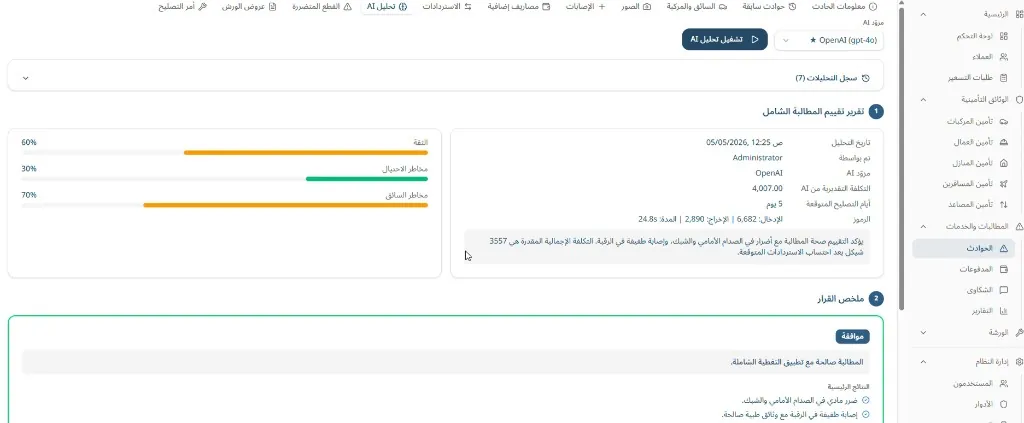
On screen: a structured report with gauges (confidence, fraud risk, driver risk), decision summary, token/time metadata, and traceable sections so reviewers can move from registration to assessment with less repetitive manual work — while final underwriting decisions remain human-led where policy requires.

02

AI Analysis workspace

The dedicated tab shows model choice, run controls, and a rich assessment layout — gauges for confidence, fraud risk, and driver risk alongside narrative, metadata, and decision summary aligned to the insurer workflows.

Open resource

03

Phase 1 — vision on every frame

Parallel per-image analysis with optional baseline pairing yields structured damage lists, severities, bilingual descriptions, and confidence — the “structural inspector” pass before whole-file reasoning.

Open resource

04

Phase 2 — reasoning on the full dossier

Image findings are consolidated with financial, injury, and parts data for holistic consistency, pricing linkage, and an overall recommendation — without re-sending full binaries in the second pass for stability and speed.

Open resource

05

Value in one line

Less repetitive manual work and faster alignment for adjusters; clearer, data-backed narratives for leadership — same data you enter today, smarter next step tomorrow.

Open resource

06

Key features

Accident file tabs

accident info, driver & vehicle, images, injuries, extras, recoveries, AI Analysis, damaged parts, workshop offers, repair order.

Model selector (e.g. OpenAI GPT-4 class) with Run AI analysis and analysis history for auditability.

Risk & confidence readouts plus estimated repair cost and duration hints to align desk review.

Bilingual Arabic/English outputs to reduce ambiguity between departments.

Baseline-vs-accident photo pairing to highlight new vs pre-existing damage.

Reference parts pricing hooks so visual findings map to reviewable numbers.

Designed as a decision assistant — amplifies insurer expertise; does not replace mandated human judgment.

Next story

Health Insurance Member App
Talk to the team

Have a system to build?

Tell us the problem. An engineer — not a salesperson — replies within one working day.